When people talk about Kubernetes backup, many still think in an overly simplified way: export YAML, copy volumes, and assume the problem is solved. In practice, that is rarely enough. A real Kubernetes environment involves cluster resources, namespaces, persistent volumes, object storage, retention policies, restore workflows, cluster migration, and version compatibility.
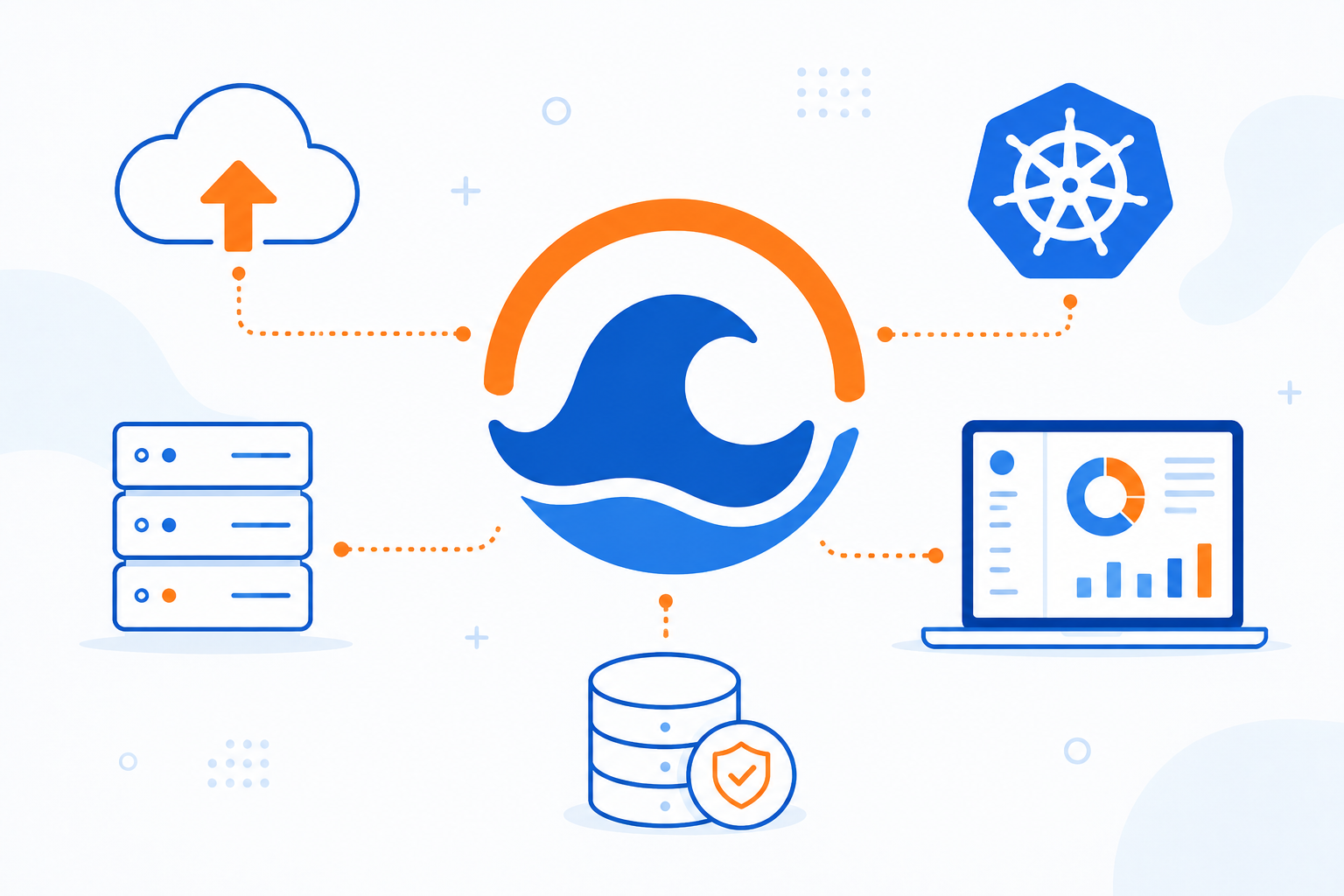
That is exactly the context in which Velero became one of the best-known open source tools for protecting Kubernetes workloads. The Seawise Dashboard for Backups fits into a different layer: not as the backup engine itself, but as a management and operations interface for backups and restores performed with Velero and, in OpenShift environments, with OADP.
What Velero Is
Velero is an open source tool focused on backup, restore, disaster recovery, and migration of Kubernetes cluster resources and persistent volumes. In practical terms, it was created to protect application state and associated data inside Kubernetes environments.
In practice, Velero allows you to:
- back up cluster resources;
- restore those resources in case of loss, error, or outage;
- migrate workloads between clusters;
- protect persistent volumes through snapshots or filesystem-level backup, depending on the platform and the chosen configuration.
Velero’s operational model usually involves two main components:
- a server running inside the cluster;
- a command-line client used to create, list, describe, and restore backups.
What Velero Backs Up
Velero mainly works with two protection domains.
1. Kubernetes resources
The first domain is the cluster objects themselves, such as:
- namespaces;
- deployments;
- services;
- configmaps;
- secrets;
- CRDs and other resources exposed through the Kubernetes API.
This backup is built from the cluster API, which allows part of the environment’s logical state and configuration to be reconstructed.
2. Persistent volumes
The second domain is persistent data. Depending on the platform, Velero can use:
- native storage snapshots;
- filesystem-level backup, when native snapshot support does not exist, is not available, or is not sufficient.
This matters because it shows that Velero is not just a manifest export tool. It was designed to serve as an operational protection solution for Kubernetes environments.
How Velero Works
The basic Velero backup flow is relatively straightforward.
When a backup is created, Velero:
- processes the request;
- queries the Kubernetes API;
- collects eligible resources;
- writes the backup metadata to the backup storage;
- and, when required, also handles snapshots or volume backup.
For restore, the logic runs in the opposite direction:
- Velero reads the stored backup content;
- processes the objects;
- validates restore conditions;
- and recreates resources in the target cluster or in the original cluster, depending on the scenario.
Another important point is that Velero also supports:
- on-demand backups;
- scheduled backups;
- retention through TTL;
- migration between clusters;
- and key parts of disaster recovery workflows.
Where Velero Is Strong
Velero is especially strong in four areas.
Backup and restore of Kubernetes workloads
This is the most common use case. Velero protects cluster resources and, depending on the architecture, also the persistent data.
Disaster recovery
It helps reduce recovery time in scenarios involving infrastructure loss, data corruption, or service outages, provided the environment was prepared correctly.
Cluster migration
Velero is also widely used to migrate workloads and resources between Kubernetes clusters, which is useful during environment refreshes, datacenter moves, or platform rebuilds.
Scheduling and retention
Instead of relying on improvised scripts, Velero provides its own mechanisms for backup scheduling and expiration through retention policy.
Where the Seawise Dashboard for Backups Fits
This is where the Seawise Dashboard for Backups comes in.
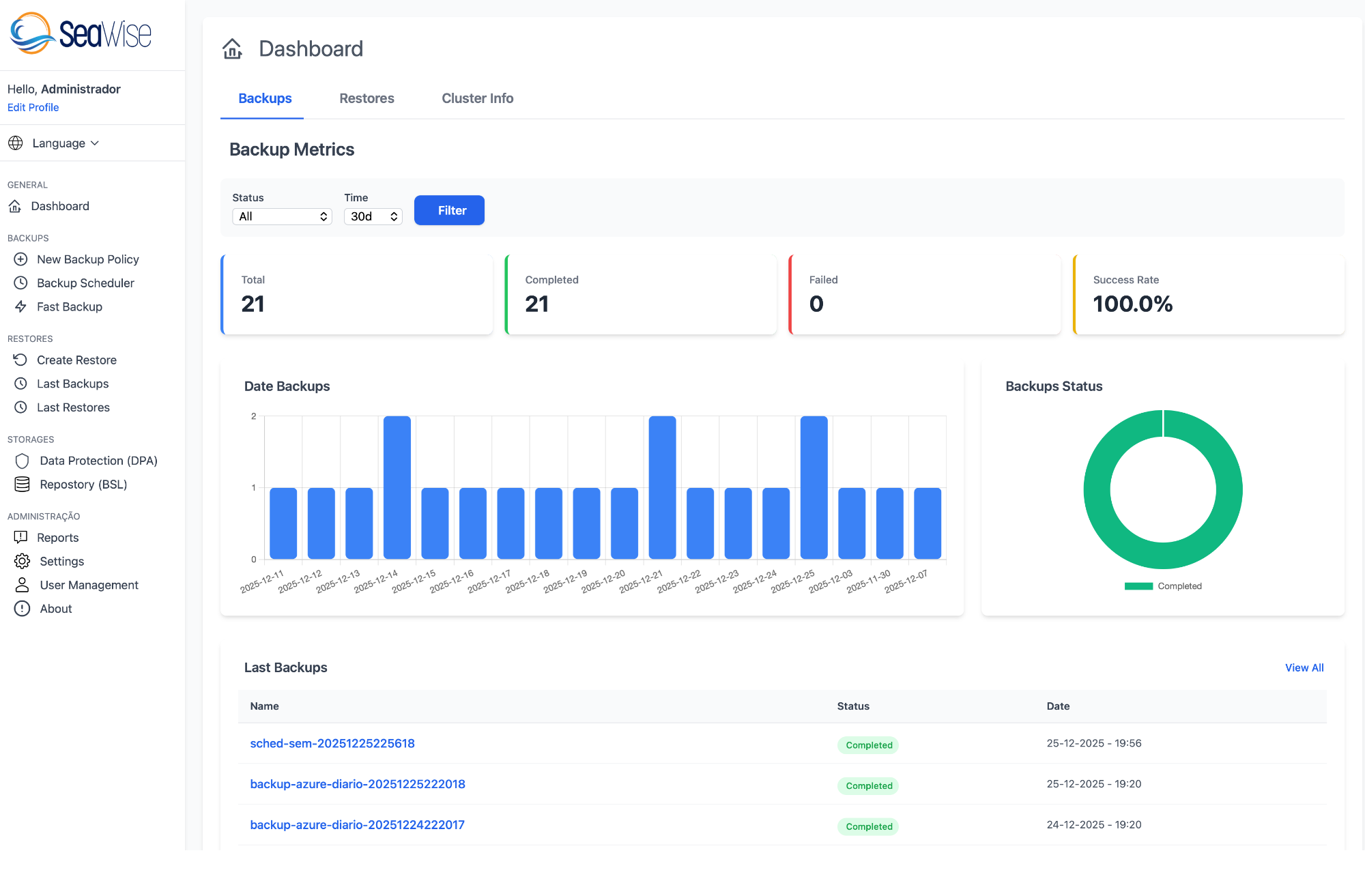
The most important point is this: Seawise is not the component that executes the cluster backup itself. Its role is different. It works as a management, visualization, and operations layer on top of backups performed with Velero and, in OpenShift environments, also with OADP.
That distinction matters because it avoids positioning Seawise incorrectly. Velero remains the component responsible for backup, restore, disaster recovery, and migration. The Seawise Dashboard acts as the web interface used to administer that ecosystem.
In other words:
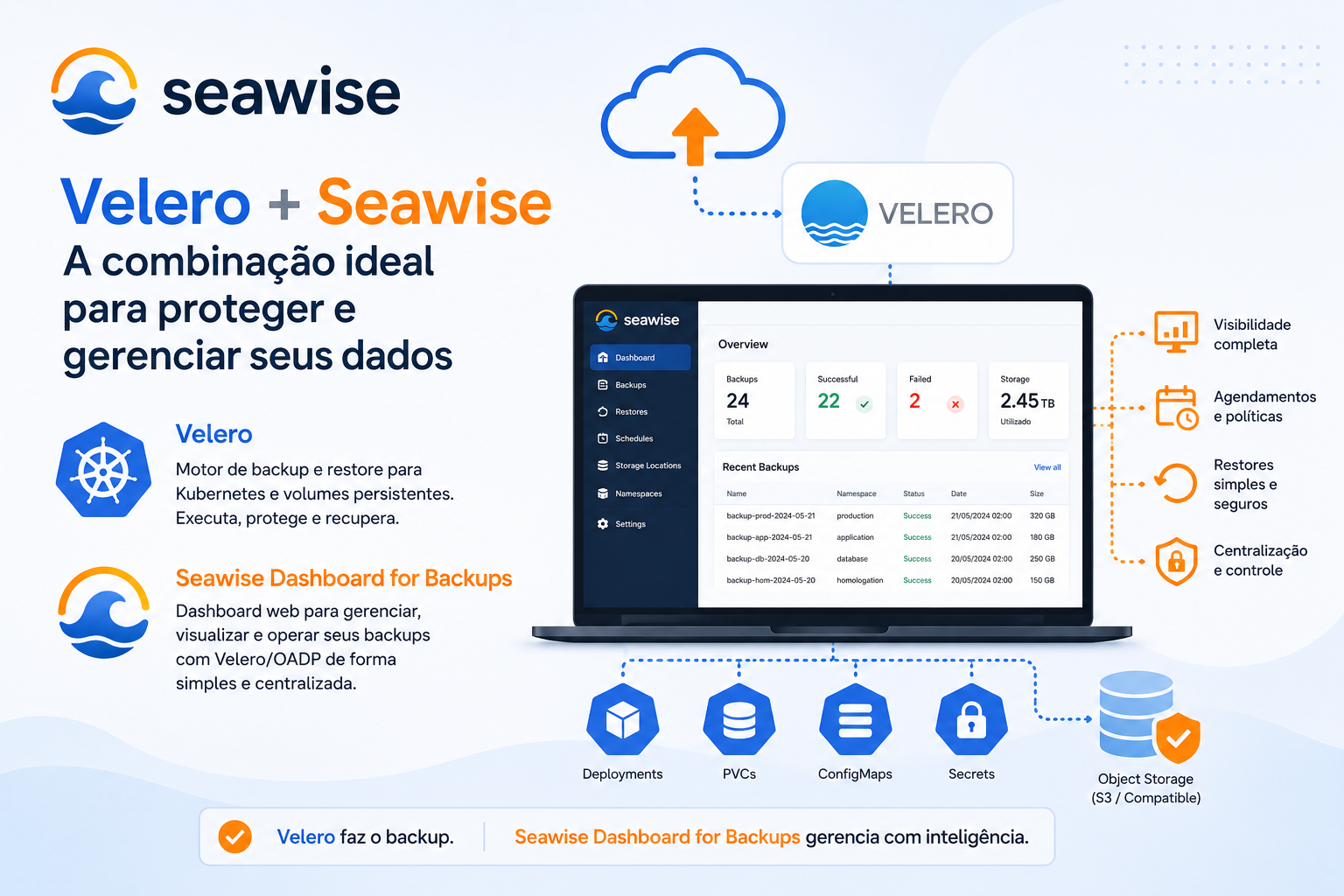
- Velero is the operational backup and restore engine;
- the Seawise Dashboard for Backups is the management layer on top of that process.
How the Seawise Dashboard Helps Manage Backup Operations
1. It centralizes operations
With raw Velero, much of the operational work goes through CLI commands, custom resources, log inspection, and manual review of cluster objects. That works, but it concentrates knowledge in a small number of people and makes daily operations harder.
The Seawise Dashboard helps by offering a web interface to organize those routines in a central place.
2. It improves visibility
A backup operation is not only about “having a backup created.” It also depends on knowing:
- which backups exist;
- which restores were executed;
- what the status of operations is;
- where the storage location is;
- and how the operational history of the environment looks.
The dashboard helps specifically at that visibility and monitoring layer.
3. It makes management easier across Kubernetes, Rancher, and OpenShift
The project is positioned to work with Velero/OADP in multiple contexts, including Kubernetes, Rancher, and OpenShift. That helps teams that want a single interface to manage different environments without depending entirely on manual commands.
4. It helps standardize operations
When each operator works differently, the process becomes messy: one uses CLI, another uses scripts, another edits YAML manually. A dashboard helps introduce a more standardized administration layer.
5. It reduces command-line dependence for routine tasks
Velero still requires technical knowledge, especially around architecture, storage, restore behavior, and compatibility. But the Seawise Dashboard can reduce command-line dependence for more routine operational management and monitoring tasks.
Why This Combination Makes Sense
The combination of Velero and the Seawise Dashboard for Backups makes sense because each one operates at a different layer.
Velero handles the functional and technical part of protecting workloads and data in Kubernetes. The Seawise Dashboard helps make that operation more manageable on a daily basis.
This is especially useful in scenarios such as:
- clusters with recurring backup and restore requirements;
- OpenShift environments using OADP;
- teams with more than one operator;
- the need for operational visibility;
- the need to standardize process across multiple clusters.
Conclusion
Velero is one of the most relevant open source tools for backup, restore, disaster recovery, and migration in Kubernetes. It is the component that actually performs the protection of cluster resources and persistent volumes according to the adopted architecture.
The Seawise Dashboard for Backups should not be understood as the backup software itself. The more accurate definition is that it is a management and operations interface for backups performed with Velero and OADP.
The most precise way to describe this architecture is:
- Velero protects the cluster resources;
- the Seawise Dashboard helps manage that protection.
That positioning is technically more accurate, more useful, and more realistic when explaining the role of each component in a Kubernetes backup strategy.